Extractions
Atraumatic extraction: buffered anesthesia, piezosurgery, laser ozone, PRF membrane placed for healing, and option for immediate ceramic implant placement.
Gentle Forces: We use leverage instead of strong forces, section the tooth, and use Piezosurgery to cut bone in key points to minimize trauma, which means less pain post-extraction.

Disinfection: We use manual curretes, lasers and ozone to disinfect the socket reducing the risk of infection.
PRF: We use it as a healing matrix that also helps as a non-chemical glue to seal the incisions and make a sticky bone graft.
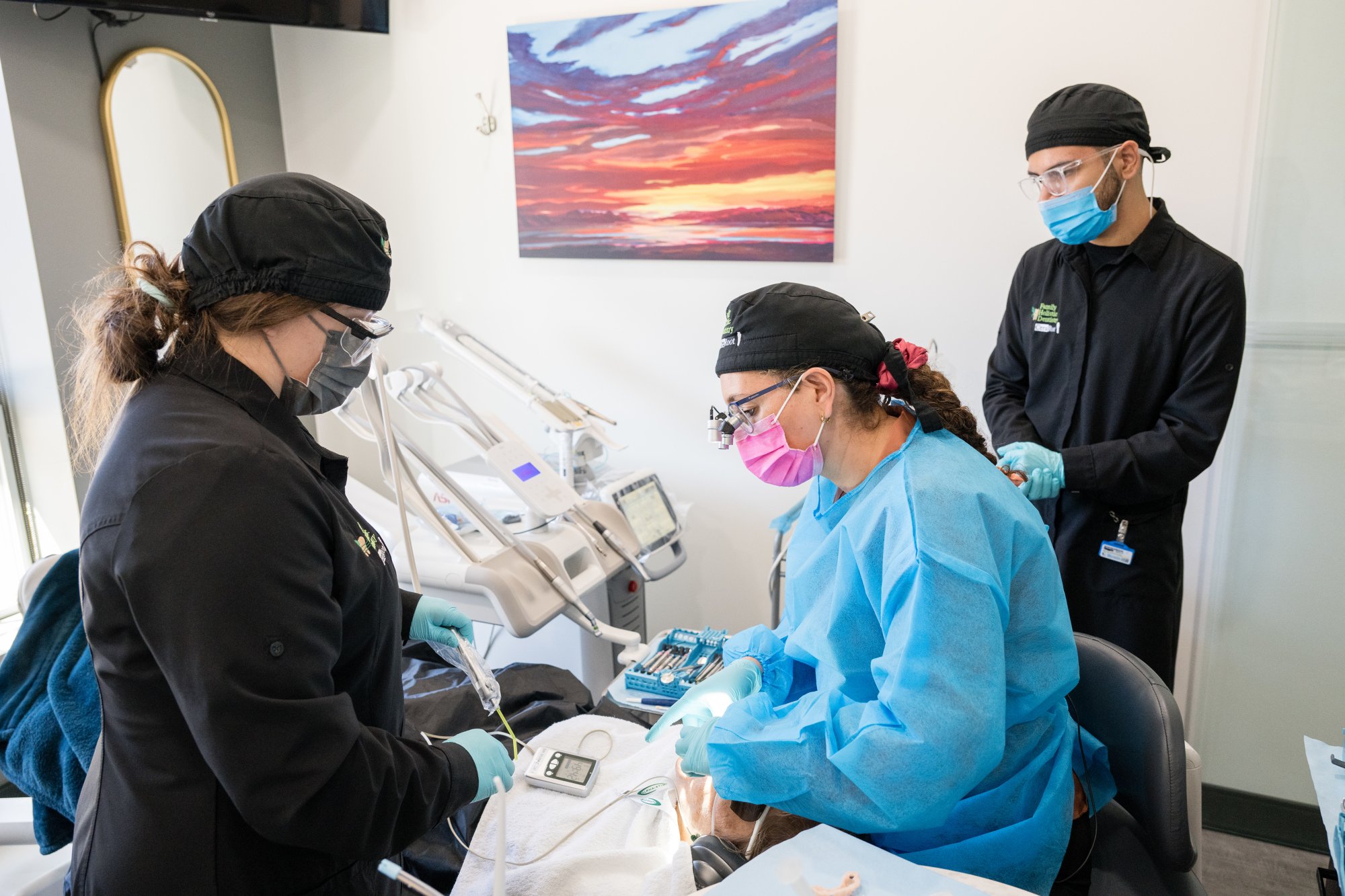
When we remove a tooth, we do an atraumatic extraction. This technique is designed to remove the tooth using specialized tools while causing minimal damage or trauma to the surrounding bone and tissues.
To do this, we use Piezosurgery, a procedure that involves using ultrasound waves to cut into bone. We use gentle pressure at key points to use leverage instead of brute force. The waves do not damage surrounding tissue, giving Piezosurgery its distinct advantage. We will then remove the periodontal ligament, disinfect the socket with ozone and laser, and then place a PRF membrane that we got from the patient’s blood draw before the procedure. We have had great results with this protocol. The healing is excellent, and the pain is minimal. Maintaining the bone between the roots (interarticular bone) allows us, in most cases, to place a ceramic implant immediately after extraction. You can visit our service page for more information on ceramic implants. To further support healing, we often provide a custom-made Essix retainer. This clear appliance helps protect the bone graft, PRF membrane, and sutures from everyday forces, while also maintaining the position of surrounding teeth and preventing unwanted movement during the healing phase. It can be easily adjusted if needed, and our team is always here to help with any comfort concerns.

About Dr. Burke
Dr. Carmen Burke graduated from Loma Linda University Dental School. She is on the perio committee of the IAOMT and is a certified CeraRoot instructor. She has placed around 625 ceramic implants and teaches a course on one-piece CeraRoot implant placement and her holistic protocol with the CEO of CeraRoot Dr. Xavi Oliva.
Testimonial:
Extraction and immediate implant

“No pain” after the extraction/implant procedure.
The patient was able to have a permanent crown three and a half months after extraction.
“We often provide a custom-made Essix retainer to protect the healing site after extraction. It shields the bone graft, PRF membrane, and sutures while maintaining tooth position and preventing unwanted movement during this important healing phase.”
PRF:
Platelet rich fibrin (PRF)
PRF treatment has gained immense popularity recently due to its remarkable benefits. This technique utilizes the patient's own body's growth factors and blood to promote tissue healing support. For more information on PRF see our blog post.

Before extraction, we draw four tubes of the patient’s blood and place it in our PRF centrifuge.
When we run the centrifuge, it is processed to separate the platelets and fibrin—the essential components responsible for healing and tissue repair support.
The output of this process is a PRF membrane that we place into the socket of the extracted tooth.
I have done hundreds of extractions before using PRF, and the difference in healing is night and day when using PRF.
“I have been performing extractions since 1995. In the past, patients experienced post-operative pain after extractions, but since I started using my holistic approach in 2017, patients have experienced minimal pain and much better healing.”
Post Op Instructions
-
Do not blow your nose for 4 weeks if your extraction was in the upper arch. This will allow better healing.
-
If you can, take ibuprofen 400-600 mg every 4-6 hours for the first 48-72 hours while awake. Please be sure not to exceed 3200 mg per day. This will help control pain and swelling. If ibuprofen is not adequate for pain control, Acetaminophen 500 mg could be taken with the ibuprofen( both tablets simultaneously) please be sure not to exceed 4000 mg of acetaminophen daily. If after trying these two medications together the pain is still present please inform Dr Burke and she can prescribe a stronger medication or an alternative one, it depends on your needs.
-
ItemIf you had an infection, you may have been prescribed an antibiotic. Be sure to take the prescribed antibiotics as directed to help prevent further spread of the infection. Discontinue antibiotic use in case of a rash or other unfavorable reaction and notify our office or Dr. Burke directly. Otherwise, please finish your entire course of antibiotics. Antibiotics can sometimes cause an upset stomach. If this is the case, taking acidophilus or probiotic tablets along with your antibiotic is advisable. Women taking oral contraceptives: antibiotics that you have received for your surgery may make your oral contraceptive less effective. You should use an alternate form of birth control until your normal menstrual cycle. description
-
Partial dentures or flippers should be worn only in social settings until you are fully healed. When at home, remove your prosthesis to allow the healing extraction site a chance to breathe.
-
What if it feels tight or uncomfortable?
Is tightness normal?
Yes—because it’s custom-made, it will feel snug at first. With use, it naturally relaxes and becomes more comfortable.Why does it press into my gums?
Around days 3–4, normal inflammation peaks. This can make it feel like it’s “digging” slightly—this is temporary.Can I adjust it at home?
Yes, small areas can be gently smoothed with a clean nail file or scissors. We are always happy to help you in the office.Why does food get trapped?
We intentionally create space to allow for swelling, so some food may collect. Clean regularly to keep the area fresh.Is odor normal?
Yes. Healing tissues and trapped food can create a temporary odor. This improves as healing progresses. -
When you arrive home and are settled comfortably, apply ice packs to the outside of your cheek over the extraction area and keep them in place for 10 minutes. Then rest for 10 minutes and repeat the cycle ( 10 minutes on and 10 minutes off your cheek) for 24 hours after surgery. Having those intervals of 10 minutes would prevent burning your skin. Ice cubes in a baggie, a dish towel, or gel packs from any pharmacy will work fine. It is also helpful to elevate the head slightly higher than the heart. We will give you an ice bag at the time of the extraction to place on your cheek when you leave the office.
-
Resting is therapeutic, and this helps your energy focus on healing the extraction site. To minimize further bleeding, do not become excited or overexerted. Sit upright and avoid exercise. Do not disturb the wound. After the blood clot forms, it is important not to dislodge it, as it aids healing.
-
Once the gauze packs have been removed, it is fine to eat and drink. The food should be very soft, requiring very little chewing (avocado, yogurt, pudding, scrambled eggs, etc.), and beverages should not be carbonated or hot (water is best). Do not eat or drink anything extremely hot until the numbness is completely gone so as not to burn your lip or tongue. Don’t bite your lip while is numbed, you can get a wound without noticing it.
-
This is to help avoid dislodging the blood clots that form in the extraction site/s. If the blood clot is dislodged, a painful dry socket can occur.
-
Your stitches may be the dissolving type. Do not be alarmed if they come out on their own after 3 days and /or begin dissolving out on their own 7-10 days following surgery. If you do not have dissolving stitches, you must return to the office 7-10 days after surgery to remove them.
If a membrane is placed, you will be informed and should come back in 3-4 weeks to have it removed with the stitches.